

From kings to coastlines
Polo’s long gallop to Sandbanks
On a bright summer afternoon in Poole, the sight of thundering hooves against a backdrop of sea and sky feels both exhilarating and faintly surreal. Yet the arrival of polo on the sands of Sandbanks is not a novelty act; it is the latest chapter in one of the world’s oldest and most evocative sports. As SandPolo prepares to thunder into its 19th year, it is worth pausing to consider how a game once played by warrior kings has found such an at-home rhythm on Dorset’s shoreline.
Polo’s story begins far from the English coast. Historians trace its origins back over 2,000 years to Persia, where it served less as leisure and more as military training. Cavalry units honed speed, agility and horsemanship with a bat and ball, learning to manoeuvre as one with their horses. From there, the game travelled along the Silk Road, enjoyed by emperors in China and maharajas in India, before eventually arriving in Britain during the colonial era of the 19th century.


PICTURED LEFT SandPolo Founder, Johnny Wheeler
The British gave the sport many of the structures we recognise today. Clubs were formed, rules standardised, and polo evolved into the fast, elegant contest associated with summer lawns, crisp whites and champagne on the sidelines. At its heart, however, the essence of polo remained the same: skill, bravery, teamwork and that unique partnership between horse and rider.
That partnership is often underestimated. While the players may take the headlines, seasoned polo aficionados know the true stars wear horseshoes, not helmets. The polo ponies, a bit of a misnomer, as many stand well over 15 hands, are extraordinary athletes. Bred specifically for speed, balance and intelligence, they are trained to accelerate, spin and stop with breathtaking precision. In many ways, they are the gladiators of the modern arena, and a great pony can transform a good player into a formidable one.
Traditional grass polo is played with four riders to a side on a vast pitch, often stretching over 300 yards long. It is thrilling, but expansive; the action ebbs and flows across a large canvas.
SandPolo, by contrast, tightens the frame and raises the intensity. It is played in an enclosed arena on sand, beach polo typically features three players per team. The pitch is smaller, and the action comes thick and fast. The ball moves quickly but not as freely as on turf, encouraging close control and rapid-fire passing. For spectators, this creates an electrifying experience: you are not watching from a distant pavilion, but close enough to feel the sand lift beneath each turn and hear the thud of hooves as ponies dig in.

The rules of SandPolo are designed to keep the game flowing and, above all, safe. Chukkas, the periods of play, are shorter, reflecting the more physical nature of the surface. Ride-offs, where players jostle shoulder to shoulder for possession, still apply, as does the fundamental “line of the ball” rule that governs right of way and prevents dangerous crossing. Umpires remain vigilant, whistles quick to follow any infringement that could endanger horse or rider. The result is a game that is compact, tactical and undeniably compelling.
So how did this ancient sport find such fertile ground on Sandbanks? The answer lies in both innovation and accessibility. Nearly two decades ago, the idea of bringing polo to the beach was sparked by a desire to open the sport up to a wider audience. Away from private estates and exclusive clubhouses, SandPolo places the game in a truly public arena. Locals, holidaymakers and seasoned polo fans can stand shoulder to shoulder, united by the thrill of the contest.
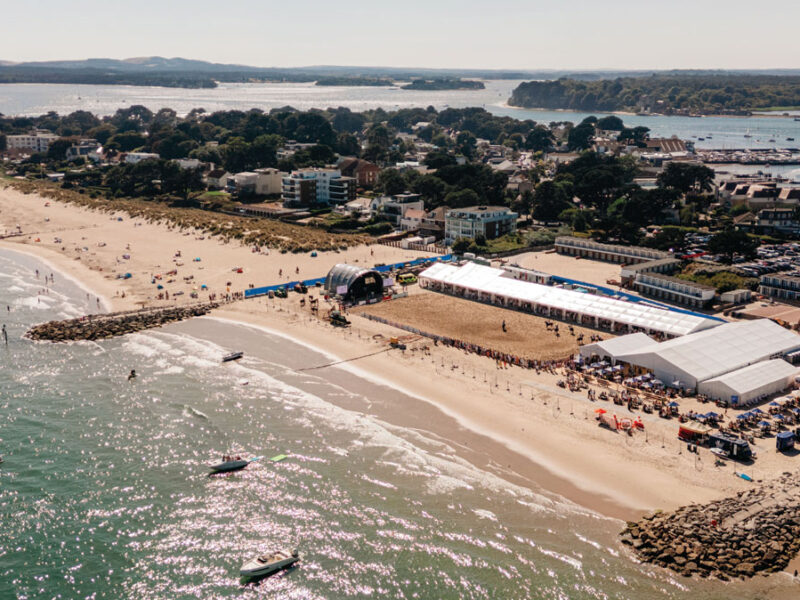
Sandbanks itself provides the perfect stage. The natural amphitheatre of the beach, framed by calm waters and expansive skies, lends a cinematic quality to the event. Add live music, hospitality tents and a relaxed coastal atmosphere, and SandPolo becomes not just a sporting fixture but a summer festival and one that has truly embedded itself into Poole’s social calendar.

Its success over 19 years is no accident. Riders relish the challenge of a different surface; ponies, trained meticulously for the sand, show off their versatility and courage. Sponsors and spectators are drawn by the blend of sport and spectacle, tradition and reinvention. Crucially, the event has remained respectful of polo’s core values while being unafraid to shake off some of its formality.
As the players line up at the start of a match, mallets raised and eyes fixed on the ball, you can sense the weight of history behind them and the excitement of something unmistakably modern. The same instincts that once served ancient cavalry now play out a few strides from the sea.
This July, when the arena goes up once more on Sandbanks and the first chukka is thrown in, you’ll be watching more than a game. You’ll be witnessing a living tradition, galloping confidently into its future.
See you on the sand.
Join us Friday & Saturday, 10–11 July – for ticket information, visit sandpolo.com